A Homeowner’s Guide to Measuring for Replacement Windows
It’s the middle of winter, and you feel a draft coming from your living room window.
You place your hand near the frame and confirm your suspicion—cold air is seeping in.
You know it’s time for a window replacement, but before a contractor installs a new one, you need proper measurements.
While this guide will help you understand the process, window replacement isn’t a DIY job—so be sure to leave the final details to a professional.
What to know about measuring your window for replacement:
- Understand Key Window Sizing Terms
- Should You Measure Your Window from the Inside or Outside?
- Tools You’ll Need to Measure Your Window
- Full-Frame vs. Insert Window Replacement
- Why Precise Measurements Matter—And Why You Should Call a Pro
Understand Key Window Sizing Terms
When it comes to window installation, you need to understand the terminology used to describe the window dimensions.
Here’s a breakdown of the key sizing terms you need to know:
Rough Opening
The rough opening refers to the space in the wall where the window will be installed.
This isn’t the exact size of the window but rather the opening that will accommodate it.
To measure the rough opening, you need to account for both the width and height of the space.
It should be slightly larger than the window to allow for adjustments during installation.
The rough opening typically gives you a general idea of how much room you have to work with when placing the window into the wall.

Frame Size
The frame size refers to the actual size of the window frame itself—the physical structure that surrounds the glass.
This is the part of the window that is installed into the rough opening.
The frame size is typically measured and used when ordering windows. This helps ensure the frame fits properly within the rough opening.

Window Size
The window size is the size of the actual window, excluding the frame.
The manufacturer lists this measurement, which refers specifically to the glass and the window sash, which is the movable part of the window that opens and closes.

Installation Allowance
When installing a window, it’s essential to leave some space around the frame and the rough opening—usually about 1/4 inch—this is known as the installation allowance.
The space is crucial because it allows for adjustments and shimming, ensuring that the window is level, plumb, and square once it’s in place.

Should You Measure Your Window from the Inside or Outside?
For most window replacements, you’ll want to measure from the inside of the house.
This is because the inside measurements reflect the exact dimensions of the window opening where the new window will be installed.
If you’re doing a full-frame window replacement—where both the window and the surrounding frame are being replaced—exterior measurements may also be necessary.
Keep in mind that no two windows are exactly the same, even if they’re in the same room or appear to be the same size.
Always measure each window individually to ensure a proper fit.
Tools You’ll Need to Measure Your Window
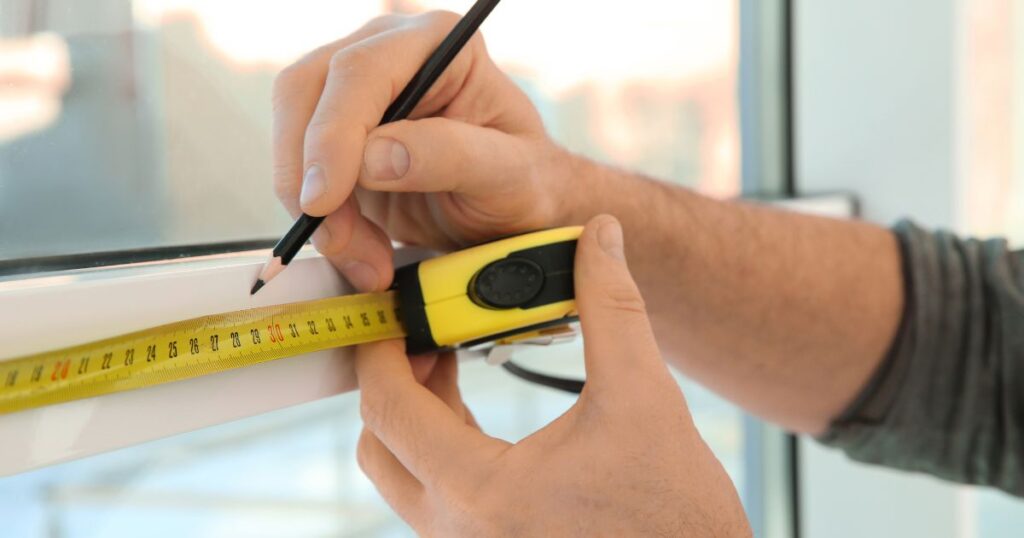
- Tape measure (preferably a locking steel tape for accuracy)
- Notepad and pen (or a notes app on your phone)
- Level (to check for squareness)
- Step ladder (for taller windows)
Full-Frame vs. Insert Window Replacement
When it comes to replacing your windows, you’ll encounter two main options: insert replacement and full-frame replacement.
Insert Window Replacement: Ideal for Frames in Good Condition
An insert window replacement is typically the preferred choice when the existing window frame is in good shape.
With this method, you’re only replacing the window itself—the glass, sash, and internal components—while leaving the original frame intact.
For the best fit and performance, it’s recommended to use replacement windows from the same manufacturer as the original.
This is a simpler, quicker, and more cost-effective option.
Insert Window Replacement Steps
- Measure the Width – Take three horizontal measurements (top, middle, bottom) inside the existing frame. Use the smallest one.
- Measure the Height – Measure vertically from the sill to the top of the frame in three spots (left, center, right). Record the smallest.
- Measure the Depth – Measure from the front to the back of the frame. Ensure at least 3 1/4 inches of depth for a proper fit.
- Check for Squareness – Measure diagonally from corner to corner. If the difference is over 1/4 inch, adjustments may be needed for a secure fit.
Full-Frame Replacement: Necessary for Damaged or Poorly Aligned Frames
A full-frame replacement is the more comprehensive option and is necessary when the entire window frame needs to be replaced.
This method involves removing the existing window, including the frame, sash, trim, and any rotting or damaged components.
Full-Frame Replacement Steps
- Remove the Old Window – Take out the entire window, including the frame, trim, and any old insulation, exposing the rough opening.
- Measure the Rough Opening – Measure width, height, and depth from stud to stud to ensure a proper fit for the new window.
- Check for Level and Squareness – Measure diagonally and use a level to confirm the opening is square.
Why Precise Measurements Matter—And Why You Should Call a Pro
Measuring for replacement windows might seem straightforward, but even the smallest mistake leads to costly issues.
A window that’s even slightly too large or too small won’t fit properly, leading to:
- drafts
- leaks
- energy inefficiency
Plus, window openings aren’t always perfectly square—older homes, shifting foundations, and previous installations create subtle misalignments that only a trained eye can catch.
Professionals know how to measure for both insert and full-frame replacements, taking into account rough openings, frame depth, and necessary installation allowances.
They also have the right tools and techniques to ensure accuracy, saving you from the hassle of returns or ill-fitting windows.
The Next Step: Professional Help from GP Martini Roofing
Measuring for replacement windows is one of the most important steps in the window replacement process, but let’s be honest—it can be tricky.
Getting precise measurements is essential to ensure your new windows fit correctly, providing both function and aesthetic appeal.
Our team at GP Martini Roofing has years of experience measuring and installing windows, ensuring a perfect fit every time.
We’re equipped with the right tools and knowledge to account for every detail, from measuring window depth to ensuring the frame is square.
Don’t risk the discomfort and inefficiency that comes with poorly fitted windows.
Contact us today for a free estimate!

FAQs
How do you measure for replacement windows?
To measure for replacement windows, start by measuring the width and height at three points:
- top, middle, and bottom for width
- left, center, and right for height
Always use the smallest measurements to ensure a snug, energy-efficient fit for the new window.
Do you measure windows from the outside or inside?
For most replacement windows, measure from the inside. This provides the most accurate dimensions for the window opening. If performing a full-frame replacement, however, you may also need to take exterior measurements to ensure the proper fit of the new frame.
Do window sizes include the frame?
No, window sizes generally refer to the dimensions of the window itself, excluding the frame. The frame size, which includes the entire structure that holds the glass, is typically listed separately and is crucial for fitting the window into the rough opening properly.
How much bigger should a window frame be than the window?
The window frame should be slightly larger than the actual window size to allow for proper installation. Typically, a 1/4-inch space around the frame is recommended for adjustments, shimming, and ensuring the window sits level, square, and plumb within the rough opening.